
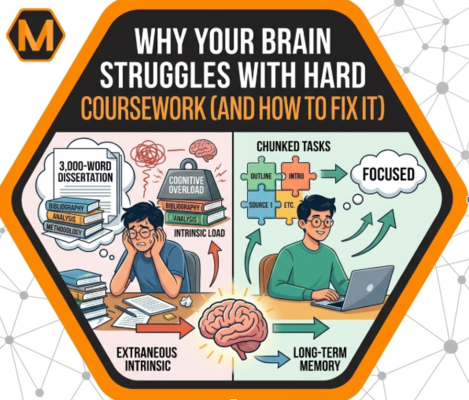
Have you ever sat down to tackle a major project, only to find yourself staring at a blinking cursor for three hours? Your phone is in another room, you’ve had your coffee, and you genuinely want to succeed—yet your brain feels like a browser with fifty tabs open, all of them frozen. This isn’t a lack of willpower. It is a biological bottleneck.
To understand why we struggle, we have to look at the “hardware” of the human mind. Our brains are masterpieces of evolution, but they weren’t exactly designed for the abstract, high-pressure demands of modern university life. When you face complex assignments, you aren’t just fighting a deadline; you are fighting a physiological limit on how much information your prefrontal cortex can process at once.
In the specialized world of educational psychology, this phenomenon is known as Cognitive Load Theory. When you are juggling complex data sets, rigorous citation styles, and critical arguments, your brain hits a “red line” of total exhaustion. To navigate this successfully, many high-achieving students find that externalizing the stress through structured coursework help from professional platforms like myassignmenthelp can provide the mental breathing room needed to actually understand the material rather than just drowning in the logistics of the paper. By reducing the “noise” of formatting and preliminary research, you allow your brain to return to its natural state of curiosity—the state where real learning happens.
The Science of the “Working Memory” Bottleneck
Our brains process information in two main stages: Working Memory and Long-Term Memory. Think of your working memory as a small, cluttered workbench and your long-term memory as a massive, infinite warehouse.
The problem with hard coursework is that the “workbench” is incredibly small. Research suggests the average human can only hold about four to seven “chunks” of information in their conscious mind at one time. If your assignment requires you to analyze a 40-page case study while simultaneously applying a theoretical framework, maintaining perfect APA grammar, and keeping track of a word count, your workbench collapses.
When this collapse occurs, your brain enters a state of Cognitive Overload. This isn’t just a feeling of being tired; it’s a measurable state where your brain stops forming new neural connections. You might read the same paragraph five times and still not “register” the meaning. This is your brain’s defense mechanism—it is literally protecting itself from a system crash by shutting down deep processing.
Breaking Down the “Weight”: The Three Types of Load
To fix the struggle, you must identify exactly what is weighing down your workbench. Educational scientists categorize mental effort into three distinct types:
| Load Type | Description | How it Affects Your Coursework | Strategy to Fix |
| Intrinsic Load | The inherent difficulty of the topic itself. | Understanding Quantum Physics is naturally “heavier” than basic math. | Break the topic into smaller, manageable “micro-concepts.” |
| Extraneous Load | The “bad weight” caused by poor instructions or messy structure. | Trying to figure out how to format a paper while trying to write it. | Use templates, clear outlines, or professional structural support. |
| Germane Load | The “good weight” used to build permanent mental maps (schemas). | This is the actual “learning” part where you connect new info to old info. | Maximize this. This is the only load that actually makes you smarter. |
If you find that your “Extraneous Load” (the stress of formatting, sourcing, and organizing) is so high that you aren’t actually learning the “Intrinsic” material, your education is being wasted. This is the moment many students decide to get someone to do your assignment or assist with the heavy lifting of data collection so that they can refocus their limited cognitive energy on mastering the core concepts.
Why “Hard” Work Often Fails
We are often told that “hard work” is the key to success. However, in the realm of the brain, “hard” work can actually be counterproductive if it leads to Germane Overload. When you force your brain to work in a state of high stress, you trigger the amygdala—the brain’s fear center. This effectively “locks” the gates to the hippocampus, which is responsible for memory.
This is why you can pull an all-nighter, “finish” the work, and then remember absolutely nothing about it two days later. You finished the task, but you didn’t learn. To fix this, we need to move from “Hard Work” to “Brain-Optimized Work.”
Four Human-Proven Strategies to “Hack” Your Brain
Once you accept that your brain has a hardware limit, you can start working with your biology instead of fighting it.
1. The “Chunking” Method
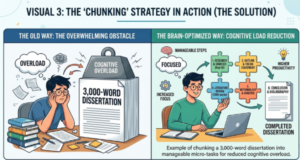
Never look at a 5,000-word dissertation as one task. Your brain perceives that as a “threat,” which triggers a procrastination response (a biological flight-or-fight reaction). Instead, “chunk” the assignment into micro-goals that take no more than 30 minutes.
- Goal 1: Find three peer-reviewed sources.
- Goal 2: Write the abstract.
- Goal 3: Outline the three main pillars of the argument.
By focusing on one “chunk” at a time, you keep your working memory under the red line, allowing for better quality work.
2. Externalize Your Schema (Mind Mapping)
Don’t try to hold the structure of your coursework in your head while you write. This is like trying to build a house while also trying to memorize the blueprints at the same time. Use a physical whiteboard or a digital mind map to lay out your arguments visually. When you can see your ideas in front of you, your working memory is freed up to focus entirely on the nuances of your writing.
3. The “Diffuse Mode” Reboot
The most brilliant insights rarely happen when you are staring at a screen. They happen when you are in “Diffuse Mode”—a state where the brain wanders. This is why we have our best ideas in the shower or during a walk. Every 50 minutes of work, take a 10-minute break without your phone. Looking at a phone is just more “input” for your working memory. A walk without a screen allows the brain to “defragment” and move information from the workbench into the warehouse.
4. Strategic Outsourcing of “Noise”
High-level professionals—from doctors to CEOs—use assistants to handle the logistics so they can focus on their “Zone of Genius.” Students should be no different. If the technicalities of a bibliography or the formatting of a complex case study are preventing you from actually thinking deeply about your subject, using an academic resource is a strategic move, not a shortcut. It’s about optimizing your “Germane Load.”
The Role of Curiosity in Academic Success
The site Pursuit of Curiosity exists because humans have a natural drive to understand the “Why” behind the world. However, the modern academic system often buries that curiosity under a mountain of “How”—how to cite, how to format, how to submit.
When we allow ourselves to become overwhelmed by the logistics of assignments, we lose the very spark that makes education valuable. True academic excellence isn’t about who can suffer the most; it’s about who can manage their mental energy the most effectively.
Conclusion: Work Smarter, Not Harder
Your brain is not a computer; it is a biological organ with specific needs. By understanding Cognitive Load Theory, you can stop blaming yourself for “laziness” and start diagnosing your “overload.”
Frequently Asked Questions
What exactly is Cognitive Load Theory?
It is a psychological framework that explains how our mental “bandwidth” is divided during learning. It suggests that since our working memory has a limited capacity, academic tasks should be structured to reduce unnecessary distractions and focus purely on the core material.
How can I tell if I am experiencing cognitive overload?
Common signs include reading the same sentence multiple times without comprehension, feeling a sense of “mental fog,” and experiencing sudden irritability or procrastination when facing a complex task. This happens when the information being processed exceeds your brain’s physical limits.
Is there a way to increase my working memory capacity?
While you cannot significantly change the biological size of your working memory, you can make it more efficient. Techniques like “chunking” information into groups and using visual diagrams allow you to process much larger amounts of data without crashing your mental system.
Why does taking a break actually help with hard assignments?
When you step away, your brain shifts into “diffuse mode” thinking. This allows your subconscious to organize information and make creative connections that aren’t possible when you are intensely focused. A short, screen-free break literally “defragments” your mental workbench.
About the Author
Ruby Walker is a dedicated academic researcher and educational consultant who explores the intersection of cognitive science and student performance. As a lead contributor for MyAssignmentHelp, she focuses on developing strategies that help learners overcome psychological barriers to achieve their full potential. Ruby is passionate about bridging the gap between complex theory and practical academic success.